
ZhongQi Growth ZhongQi Growth

Why Use Ratchet Strap Tie Downs for Cargo?

Time:2026-09-28 Author:Liam
0%

Cargo rarely stays perfectly still during a trip. A sudden stop, a rough road, or a sharp turn can shift boxes and equipment. Even a small movement may damage a delicate load or affect how weight sits on a vehicle. Ratchet strap tie downs help hold cargo in place by applying controlled tension. The Ratchet Strap Tie is useful when a load needs a firm, adjustable hold rather than a quick wrap. Its handle lets you tighten the webbing in small steps. You can feel when tension builds. That practical feedback helps, but it does not replace careful inspection. Small checks matter.

Choose a strap with a suitable working load limit, length, and width for the cargo and anchor points. Check the webbing, stitching, hooks, and ratchet for visible wear before use. Position the strap over a stable part of the load, and protect sharp edges that could cut or abrade the webbing. Tighten until the cargo is secure, not until the strap or load is distorted. Then check the anchor points and recheck tension after the load settles. It is easy to over-tighten when a strap feels reassuringly solid. That deserves a pause. A secure load depends on the whole setup: sound straps, suitable anchors, balanced cargo, and attentive handling. A ratchet strap helps, but it cannot fix poor placement.
Why Use Ratchet Strap Tie Downs for Cargo?

How Ratchet Tie-Downs Work: Webbing, Ratchet Mechanism, and End Fittings

Why Use Ratchet Strap Tie Downs for Cargo?

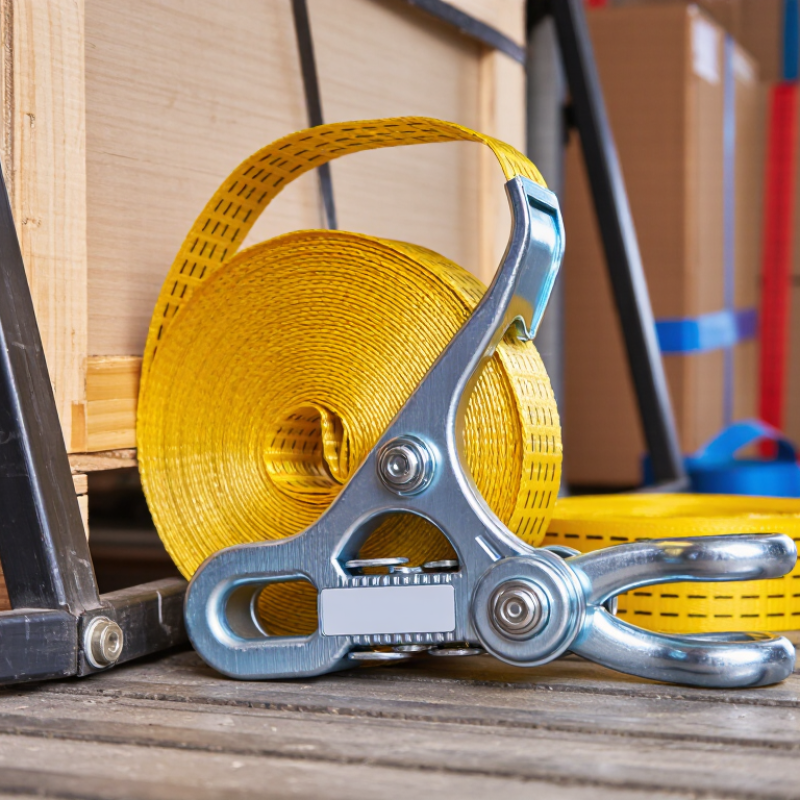
A ratchet tie-down combines webbing, a tensioning mechanism, and end fittings to hold cargo in place. Polyester webbing is commonly used because it resists abrasion and stretches less than many alternatives. Under load, the flat strap spreads pressure across a wider area than a thin rope. Still, sharp metal edges can cut it quickly.

The ratchet’s handle turns a spool, drawing in slack and tightening the webbing. Its pawl locks the spool between pulls, helping maintain tension during transport. End fittings connect the strap to anchor points; hooks, rings, and flat fittings suit different setups. Check that each fitting is fully seated. A partly engaged hook can look secure, but it may not be.

FMCSA cargo-securement rules, 49 CFR 393.106(d), specify an aggregate working load limit of at least half the cargo’s weight for applicable tiedown arrangements. That is a baseline, not a reason to ignore load shape, anchor strength, or strap condition. Small details matter.

Tips: Keep webbing flat, protect it from sharp edges, and inspect stitching, hooks, and ratchet teeth before use. Replace damaged straps. A quick check helps.

How to Choose a Strap by Working Load Limit (WLL), Not Breaking Strength

A ratchet strap can feel reassuring when its handle clicks tight, but a tight strap is not automatically a safe one. Choose by the Working Load Limit (WLL) shown on its label. WLL indicates the load the strap is rated to secure under specified conditions. Breaking strength is the force at which the strap may fail in a test. It is not a usable cargo rating. That distinction matters. A strap with a high breaking strength may still have a much lower WLL.

Check the label before loading, and make sure it is legible. Use the WLL—not breaking strength—to assess whether the straps suit the cargo and tie-down arrangement. The total capacity can depend on strap direction, anchor points, and how many straps share the load. A strap pulling at an angle may contribute less restraint than expected. Inspect webbing for cuts, fraying, melted spots, and damaged stitching; check the ratchet and hooks, too. Keep straps flat, protect them from sharp edges, and follow the maker’s instructions. It is easy to overtighten a handle. Pause and check that the cargo is stable without crushing or deforming it. If the load shifts during a short drive, stop somewhere safe and reassess the setup. A label helps, but it cannot account for every real-world detail.

How to Calculate Securement: FMCSA Requires Aggregate WLL of at Least 50%

Ratchet strap tie-downs make tension adjustable, but the calculation starts with the cargo’s weight and each strap’s working load limit (WLL). FMCSA’s Cargo Securement Rules, 49 CFR 393.106(d), require aggregate tiedown WLL of at least 50% of the cargo weight. A 4,000-pound load therefore needs at least 2,000 pounds of aggregate WLL. That is the minimum, not a promise that the load cannot shift. Use the WLL shown on the strap label, never its breaking strength. That distinction matters.

Add the WLL values according to how each tiedown is arranged; some configurations count a tiedown differently under the rules. For example, four tiedowns counted at 500 pounds each provide 2,000 pounds aggregate WLL. Check the label before loading. Then inspect webbing, stitching, hooks, and ratchets for cuts, fraying, bends, or poor engagement. A tight handle can still hide damaged webbing. Recheck tension after the load settles, and consider cargo shape, contact points, and movement direction when choosing securement. The 50% figure is easy to calculate; applying it well takes judgment, and a neat-looking setup can still deserve a second look.

How to Position and Tighten Tie-Downs for Cargo Stability

Place ratchet strap tie-downs over solid sections of the cargo, not loose covers or fragile edges. Keep each strap as straight as possible between its anchor points. Angled straps can let a load shift sideways. For a tall item, use separate tie-downs to resist movement in different directions. Add edge protectors where webbing crosses sharp corners. They help prevent cuts and reduce pressure on the cargo. Small details matter.

Pull out slack by hand before operating the ratchet. Then tighten until the load feels secure, without crushing boxes or bending panels. More force is not always safer. Check that the ratchet handle closes fully and the webbing lies flat, without twists. Use tie-downs with suitable ratings, and never rely on a visibly worn strap. Give the cargo a firm push from several sides. If it moves, reposition or add restraint. Recheck the straps after a short drive and whenever the load settles. It can be tempting to trust a tight-looking strap; a quick hands-on check is more reliable.

How to Inspect Ratchet Straps Against FMCSA Securement Force Requirements: 0.8g Forward, 0.5g Rearward and Sideways

Ratchet strap tie downs do more than hold cargo in place; they help resist forces in every direction. FMCSA’s cargo-securement rules specify performance forces of 0.8 g forward and 0.5 g rearward and sideways (49 CFR §393.102). In practical terms, a 10,000-pound load must be secured to withstand forces equivalent to 8,000 pounds forward and 5,000 pounds in either other direction. These are cargo-securement benchmarks, not a substitute for checking each strap’s working load limit.

Inspect straps before loading and after a demanding trip. Look closely at the webbing for cuts, frayed edges, melted spots, chemical damage, or stitching that has pulled loose. Check the ratchet, hooks, and anchor points for cracks, bends, or heavy corrosion. Work the handle through a full cycle; it should lock and release without sticking. Small defects matter. A strap can look fine from a distance.

FMCSA’s cargo-securement guidance also says the combined working load limit of tiedowns must generally equal at least half the cargo’s weight (49 CFR §393.106). Count only serviceable straps and use their marked ratings, not guesswork. Recheck tension after the load settles, especially when hauling dense items on a slick deck. I sometimes want to trust a tight-looking strap too quickly. That is not an inspection.

FAQS

What does a strap’s Working Load Limit mean?

The WLL is the rated capacity for securing cargo under specified conditions. Check the label.

Is breaking strength the same as WLL?

No. Breaking strength describes a test failure point, not a usable cargo rating. Don’t choose by it.

How much aggregate WLL does a 4,000-pound load need?

At least 2,000 pounds, using the article’s 50% calculation. That is a minimum, not a guarantee against shifting.

Can I simply add every strap’s WLL?

Not always. How each strap is arranged can affect how its capacity counts. Check the setup carefully.

What should I inspect before loading?

Look for cuts, fraying, melted spots, damaged stitching, bent hooks, and poorly engaging ratchets. Small defects matter.

Does a tight strap mean the cargo is secure?

Not necessarily. A tight handle can hide damaged webbing or an unstable load. Recheck the cargo, too.

How can strap direction affect securement?

An angled strap may provide less restraint than expected. Anchor points and load movement also matter.

What should I do if the load shifts during a short drive?

Stop somewhere safe and reassess the setup. Check tension and contact points. The label alone can’t judge every detail.

Can I tighten a strap as much as possible?

No. Overtightening may crush or deform cargo. Pause and check stability. I’d still want a second look.

Conclusion

Ratchet Strap Tie downs secure cargo by combining strong webbing, a ratcheting mechanism that applies tension, and end fittings suited to the anchor points. Choose straps by their working load limit (WLL), which indicates the load they are rated to secure in use; breaking strength is not the appropriate value for planning a securement. Under FMCSA guidance, the aggregate WLL of the tie-downs must be at least 50% of the cargo’s weight.

Position straps to prevent cargo from shifting, tipping, or sliding, and tighten them firmly without damaging the load or webbing. Distribute tension across suitable anchor points and recheck it after the cargo is secured. Before each use, inspect the webbing, stitching, ratchet, and fittings for cuts, fraying, deformation, corrosion, or other damage. A securement setup should also be able to resist the required forces: 0.8g forward and 0.5g rearward and sideways.

Liam

Liam

Liam is a dedicated marketing professional with a profound expertise in the industry, where he excels at highlighting the unique advantages of our core products. With a keen understanding of market trends and consumer needs, Liam frequently updates our company’s professional blog, providing......